
Bitcoin, Reasons to Believe It's Worth it
- Dec 1, 2025
- 12 min read
Updated: Dec 7, 2025
In this article, you'll learn about the fundamentals of Bitcoin and the crypto market, everything you need to know to better understand how it works and how to invest in it. At the end of the post, we've included a bonus gift that we hope you'll find very valuable.
The Beginnings
In the midst of the global financial crisis in 2008 (Lehman Brothers had fallen the previous month), an entity or group under the pseudonym Satoshi Nakamoto published a whitepaper titled "Bitcoin: A Peer-to-Peer Electronic Cash System" The document described a decentralized digital currency that would operate without the need for financial intermediaries (banks, governments). It used a public, immutable ledger (the blockchain) and "proof of work" to verify transactions and create new units. The publication date was no coincidence; the crisis of confidence in traditional financial institutions was a key catalyst.
In just over 15 years, Bitcoin and the crypto market have gone from a fringe idea for a few technology enthusiasts to a global phenomenon challenging traditional financial systems. This story is marked by extreme volatility, but also by relentless innovation and growing legitimacy.
Bitcoin Fundamentals
Satoshi Nakamoto
Satoshi Nakamoto, the mysterious creator of Bitcoin, designed the world’s first decentralized digital currency and released its whitepaper in 2008, laying the foundation for an entirely new monetary system. Remaining anonymous has been a deliberate choice that strengthens Bitcoin’s integrity:
No central authority, no leader to target, and no single individual who can influence its direction or be pressured by governments, corporations, or special interests.
By disappearing, Satoshi ensured that Bitcoin would belong to its users and to the open-source community, not to a founder figure. This anonymity is a core pillar of Bitcoin’s security and decentralization, as it eliminates the risk of concentrated power and reinforces the idea that the network operates solely according to transparent, immutable rules encoded in its protocol.

21 Million Bitcoins for 8 Billion People
The idea that 21 million bitcoins must serve a planet of more than 8 billion people represents a radical shift from the fiat monetary system, one that more closely resembles the scarcity and monetary discipline of gold than the endlessly expandable supply of government-issued currencies.
In fiat systems, central banks can print unlimited money, which leads to monetary inflation, currency debasement, and a steady erosion of purchasing power over time. Bitcoin’s hard cap of 21 million coins; fixed, transparent, and unchangeable; creates the opposite dynamic: a strictly scarce asset whose supply cannot be manipulated by any institution.
This brings Bitcoin closer to digital gold, but even more scarce and verifiable. While gold is physically limited, new discoveries can still increase its supply. Bitcoin, however, is governed by immutable code; no matter how much demand grows, no new coins can be created beyond the 21 million limit.
With a finite supply and a growing global population, Bitcoin naturally becomes divisible rather than inflated. Each bitcoin can be broken down into 100 million satoshis, allowing billions of people to use fractions of BTC without the currency losing integrity. This stands in stark contrast to fiat currencies, where supply expansion reduces the value of each unit. Bitcoin’s fixed cap therefore encourages savings, long-term thinking, and monetary discipline, similar to how gold once anchored economic systems—but with the added benefits of digital portability, transparency, and resistance to seizure or censorship.

Proof of Work (Bitcoin's System)
Bitcoin’s Proof-of-Work (PoW) system is a mechanism that ensures the network can function without a central authority. Miners compete to find a special number (a nonce) that, when combined with the block’s data and hashed with SHA-256, produces a hash that begins with a certain number of zeros. Because finding such a hash requires trying millions or billions of combinations, the process demands real computational work. But once a miner finds the correct hash, anyone else can verify it instantly. This “work” creates security, because once a block is mined, changing any part of it would require redoing all the computational effort—making tampering extremely expensive and impractical.
Proof-of-Work also establishes a fair way of deciding which version of the blockchain is valid. Instead of “one IP = one vote,” which could be easily abused, Bitcoin uses “one unit of computing power = one vote.” The valid chain is simply the longest chain with the most total work invested. As long as honest miners control most of the network’s computing power, attackers cannot catch up or overwrite history. Difficulty adjustment ensures the system stays stable: if blocks are found too quickly, the puzzle becomes harder; if miners leave and block production slows, it becomes easier. This keeps Bitcoin producing blocks at a steady rhythm, no matter how much computing power is in the network.
Proof of Work vs Proof of Stake
Proof of Work (PoW) secures a blockchain by requiring miners to solve complex mathematical puzzles using real-world energy and hardware. This makes attacks extremely costly because an attacker would need to control a majority of the network’s total computing power, something that demands enormous capital, electricity, and infrastructure.
PoW’s strength comes from its physical anchoring in energy expenditure, which creates a direct, measurable cost for producing blocks. This is why Bitcoin, the most well-known PoW system, is often considered highly secure: its security is tied to the immutable physics of energy, not human governance or software rules that can be changed through voting.
Proof of Stake (PoS), on the other hand, secures the network by requiring validators to commit (“stake”) a certain amount of the blockchain’s native currency. Instead of using energy, PoS relies on economic incentives: if a validator acts dishonestly, their stake can be slashed.
This makes PoS far more energy-efficient and capable of higher throughput, but it introduces different trade-offs. Because influence is tied to wealth rather than computational power, PoS systems can drift toward capital concentration, and their security depends heavily on social consensus and governance structures. In essence, PoW relies on external physical cost, while PoS relies on internal economic cost—each with different implications for decentralization, security, and long-term resilience.
What Are Halvings & Why They Matter
A Bitcoin halving is a pre-programmed event in the Bitcoin protocol that halves the reward miners receive for verifying and adding new blocks of transactions to the blockchain. Bitcoin miners use powerful computers to solve complex mathematical problems. The first miner to solve the problem and verify a new "block" of transactions is rewarded with a specified amount of newly minted Bitcoins, in addition to transaction fees. This block reward is how new Bitcoins enter circulation.
Halvings occur approximately every four years, or more precisely, every time 210,000 blocks are mined. Since a block is mined on average every 10 minutes, this results in a period of approximately four years.

What Characteristics Should Good Money Have?
Good money is ultimately a system of trust, a shared agreement between the people who use it and the entity that issues or verifies it. Without that trust, no currency can function, no matter how advanced or traditional it may be, but in addition to that, it must at least meet the following points:
Scarcity/Monetary Hardness: That it cannot be easily created more (limited supply or very difficult to inflate). The harder it is to increase, the better it retains value over time.
Durability: That it does not deteriorate over time (unlike, for example, using food or perishable goods as money).
Portability: That it can be moved easily and cheaply over long distances (between people, cities, countries).
Divisibility: That it can be divided into small units without losing value (to pay for everything from large purchases to very small items).
Homogeneity/Fungibility: Each unit must be equal to another unit (1 is 1, it doesn't matter which one). It shouldn't matter "which bill" or "which coin" you use.
Recognizability/Verifiability: That it is easy to verify that it is authentic and not counterfeit, without needing to blindly trust a third party.
Liquidity: That many people accept it, so that it is easy to sell it or use it to buy things (salability in space, time and scale).

Reasons to Believe in Bitcoin
Five Upsides
The narrative of Bitcoin as "digital gold" and "inflation hedge" remains strong, and growing institutional interest through products like ETFs suggests it is far from a passing fad. Its history is a testament to the perseverance, decentralized vision, and transformative power of technology.
Limited Supply (Digital Scarcity): Only 21 million Bitcoins will ever exist. This scarcity, programmed into its code, is similar to that of gold or silver, assets traditionally valued by their finite supply. As demand increases and supply remains constant (or even decreases with the loss of keys), the price tends to rise over the long term.
Consider gold. There is a finite amount of gold on Earth. If demand for gold suddenly skyrocketed globally and no new major mines were discovered, the price of gold would increase significantly. Bitcoin works similarly, but its scarcity is mathematically verifiable.
Decentralization and Censorship Resistance: Bitcoin is not controlled by any government, central bank, or corporation. It is a global P2P (peer-to-peer) network maintained by thousands of distributed nodes. This makes it resistant to censorship, manipulation, and arbitrary inflation by centralized entities.
In countries with high inflation or political instability, citizens often seek refuge in assets that cannot be easily confiscated or devalued by the government. Bitcoin offers that feature, as it cannot be printed indefinitely like fiat currency or locked by a single authority.
Growing Potential for Global Adoption: As more people, businesses, and even countries adopt Bitcoin as a medium of exchange, store of value, or investment, its intrinsic value and utility increase. The Bitcoin network grows stronger with each new user.
A few years ago, few companies accepted Bitcoin. Today, giants like Tesla (at certain times), Microsoft (for some services), and numerous online stores do so. Furthermore, El Salvador has adopted it as legal tender, and other countries are exploring its use. This widespread adoption boosts its long-term value.
Inflation Resistance (Hedge): Due to its limited supply and decentralized nature, Bitcoin is seen by many as a potential hedge against the inflation of fiat currencies. When central banks print more money, the purchasing power of that currency decreases. Bitcoin, being scarce, maintains its value.
If the European Central Bank prints trillions of euros to stimulate the economy, the value of each euro in your bank account decreases. However, the amount of Bitcoin in existence remains the same, making it a "store of value" that can protect you from that devaluation.
The "Digital Gold" Narrative: Many see Bitcoin as a digital evolution of gold. Both are scarce, portable, durable, and divisible. In an increasingly digital world, it makes sense that a digital form of gold would emerge. For centuries, gold has been a safe haven in times of economic and political uncertainty. Bitcoin is beginning to play a similar role in the digital age, offering a decentralized and global alternative.
"Hold & Buy" Bitcoin Mentality
Bitcoin has evolved from a technological curiosity to a globally recognized financial asset. The "Buy & Hold" strategy is based on the belief that, despite daily, weekly, or monthly fluctuations, Bitcoin's overall trend is upward over the years due to its fundamentals. Attempting to time the market (repeatedly buying low and selling high) is extremely difficult and, for most, less profitable than simply holding.
Understanding the fundamentals of Bitcoin (blockchain technology, decentralization, scarcity, etc.) will give you the confidence to stand firm during market downturns. The more you understand why Bitcoin is valuable, the less negative news or fluctuations will affect you.

The "Buy & Hold" strategy with Bitcoin isn't for everyone but this could also be your free way to your retirement process. It requires patience, resilience, and a deep understanding of Bitcoin's value proposition. It's not a get-rich-quick formula, but rather a path to long-term wealth accumulation, positioning yourself for the future of decentralized finance. If you're willing to do your research, tolerate volatility, and commit to a long-term vision, "Buy & Hold" Bitcoin could be one of the best financial decisions you ever make. Always remember that knowledge is power, and in the world of Bitcoin, education is your best defense against panic and speculation.
Start Accumulating Bitcoin
How & Where to Buy Crypto
Buying cryptocurrencies is easier than it seems, but it's crucial to do it safely and learn how to do it over time. There are several ways to do it, each with its own advantages and disadvantages. Now, we'll look at three really popular ways to acquire them, which we recommend the most, so you can decide which one best suits your needs depending on your type of investor.

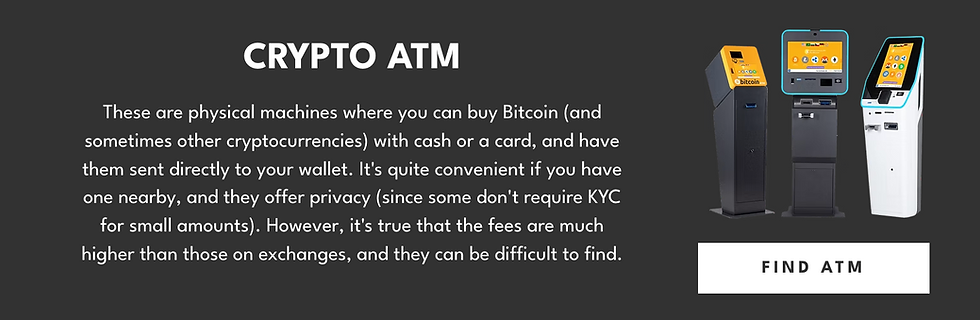


Depending on the type of strategy you want to adopt when buying and selling cryptocurrencies, one option may be more suitable for you than the other. Before embarking on any of the three options we've just explained, you should learn how to do it and clearly understand your goals. In addition, you should consider which aspects are most relevant to you (privacy, fees, security, etc.)
Store Your Crypto

Both options are quite interesting, but there are significant differences between them. If you're going to be constantly trading cryptocurrencies for short-term profits, a hot wallet could be a very good idea. However, we recommend that if you're going to accumulate Bitcoin or any other cryptocurrency for a long period of time, you should do so in a cold wallet, since you control the asset at all times and it's much less susceptible to hacking. Among the cold wallets, we recommend two: Trezor and Ledger.

Crypto Market
Most Important Crypto Projects
Along with Bitcoin, there are thousands of other cryptocurrencies, known as altcoins, that seek to offer different or improved functionality. Unlike fiat currencies (such as the euro or dollar) issued and controlled by central banks and governments, cryptocurrencies operate on peer-to-peer (P2P) networks, where transactions are verified by a network of "miners" or "validators" rather than a central authority, making them resistant to censorship and manipulation. Among the main ones cryptocurrencies, these are the biggest ones in market capitalization:
Ethereum (ETH): the second-largest cryptocurrency, goes beyond being just a currency; it's a platform that enables the creation of smart contracts and decentralized applications (dApps), laying the groundwork for innovative projects such as Decentralized Finance (DeFi), which replicates traditional financial services (lending, insurance, exchanges) without intermediaries, and NFTs (Non-Fungible Tokens), unique digital assets that represent ownership over art, music, collectibles, and other items.
Ripple (XRP): focused on cross-border payments for financial institutions. It was specifically designed to facilitate fast, low-cost, and efficient cross-border payments for financial institutions. Its main objective is to solve the slow and high-cost problems of traditional money transfer systems, such as SWIFT.
Cardano (ADA): a third-generation blockchain platform (following Bitcoin and Ethereum, which is considered second-generation), seeks to offer a more scalable, secure, and sustainable infrastructure for developing decentralized applications (dApps) and smart contracts. It focuses on solving the "blockchain trilemma": simultaneously achieving security, decentralization, and scalability, something that Bitcoin and Ethereum have struggled to balance.
Solana (SOL): is another high-performance blockchain platform designed to support decentralized applications (dApps) and cryptocurrency projects with exceptional speed and scalability. It has positioned itself as a direct competitor to Ethereum, especially in areas requiring high performance, such as DeFi, high-volume NFTs, and blockchain gaming.

Stablecoins
Stablecoins are a type of cryptocurrency designed with one fundamental purpose: to minimize the volatility of their value. Unlike Bitcoin or Ethereum, whose prices can fluctuate dramatically in a matter of hours or days, stablecoins seek to maintain a constant value, usually pegged to a real-world reference asset, such as a fiat currency (the US dollar or the euro). Their emergence in the crypto market was crucial in addressing one of the main weaknesses of cryptocurrencies: the difficulty of using them in everyday transactions or as a reliable store of value due to their unpredictable fluctuations. These are the most popular and easiest to understand. Each stablecoin issued is backed by an equivalent amount of fiat currency (e.g., US dollars or euros) or cash equivalents (such as short-term Treasury bonds) held in reserve in a traditional bank account by a centralized entity.
The idea is that for every stablecoin in circulation, there is one real dollar (or euro) in reserve. They require trust in the issuer to adequately maintain reserves and conduct transparent audits. They are the most widely used form of security in trading and serve as a bridge to traditional finance.
Tether (USDT): The largest and oldest stablecoin by market capitalization. Although it has faced criticism for its reserve transparency in the past, it has improved its reporting and remains ubiquitous in the market.
USD Coin (USDC): Issued by Circle and Coinbase (via the Centre consortium), USDC is widely recognized for its increased transparency and regularity in reserve audits, which has earned it significant institutional trust.
PayPal USD (PYUSD): PayPal's foray into the stablecoin space, pegged to the dollar. It is designed to facilitate payments on and off the PayPal network and has the potential to bring cryptocurrencies to a mass audience.

GIFT: The Promising Kaspa (KAS)
Kaspa (KAS) is a next-generation Proof-of-Work blockchain designed around the BlockDAG architecture, which allows multiple blocks to be created and confirmed in parallel instead of strictly one at a time.
This gives Kaspa an exceptional combination rarely seen in PoW networks: high throughput, extremely fast block times (1 second), and strong security rooted in energy-based consensus. Unlike traditional chains where simultaneous blocks cause forks, Kaspa’s BlockDAG processes them all coherently, resulting in a network that is fast, scalable, and still fully decentralized.
If you'd like to understand Bitcoin and the world of cryptocurrencies in a more interactive way, we highly recommend watching this full documentary, which explains much of what's covered in this article in a simple and straightforward manner.
Comments